Enterprise AI SEO agency
Enterprise AI SEO that gets your brand cited
As an enterprise AI SEO agency, we make large brands the source Google AI Overviews, ChatGPT, Perplexity, Gemini and Copilot pull from, quote and recommend, using enterprise AEO, GEO and LLMO built on the technical SEO a site your size needs.
Request a Free Quote
Tell us about your site and goals. We reply within one business day.
What enterprise AEO, GEO and LLMO actually do
Enterprise AI SEO makes a large organization’s content the source AI systems retrieve, quote and recommend. AEO (answer engine optimization) shapes pages so a passage can be lifted as the direct answer. GEO (generative engine optimization) earns citations inside generated responses, and LLMO (large language model optimization) shapes how models describe your brand from memory. AIO is the umbrella term for all of it.
Why it matters for enterprise brands
Buyers now do a growing share of their research inside an AI answer. They ask for the best vendors, the trade-offs and a rough price, and get a shortlist back before visiting a single website. If your brand is missing from that list, no ranking report will show the loss, because the click never happened.
Traffic on its own is a weak reason to invest. AI referrals are still a small share of visits for most enterprises, but they arrive late in the decision, after the answer engine has already done the comparing. Being cited works more like a recommendation than a ranking.
There is a defensive reason too. AI systems describe your company whether you take part or not, and when they get your pricing, product names or compliance status wrong, the error repeats in every conversation until the sources behind it change.
In AI search the shortlist is written before the click. Being left out costs more than ranking fifth ever did.
We treat AEO, GEO and LLMO as one system seen from three angles, and run them as a single program on top of enterprise SEO with one roadmap and one dashboard.
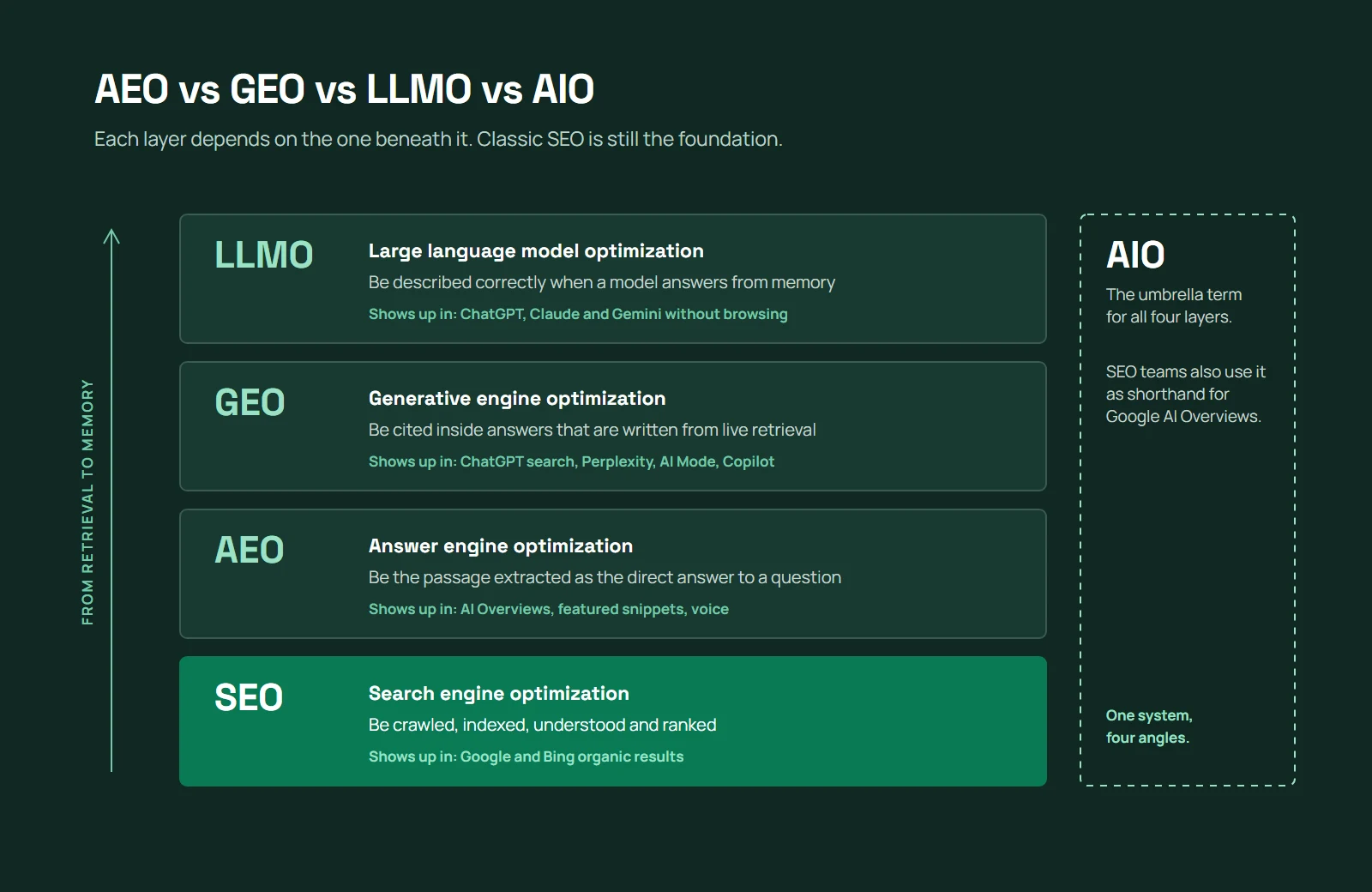
AEO vs GEO vs LLMO vs AIO: what each term covers
The terms overlap, but each targets a different surface. AEO wins the extracted answer and GEO wins the citation in a generated response, while LLMO shapes what a model says when it is not browsing at all. Enterprise AIO groups them into one program, and SEO teams also use AIO as shorthand for Google AI Overviews. All four depend on pages that search engines can already crawl, index and trust.
| Term | What it optimizes for | Where it shows up | Main levers | How we measure it |
|---|---|---|---|---|
| AEO | Being the extracted answer to a specific question | AI Overviews, featured snippets, People Also Ask, voice assistants | Question-led headings, 40 to 80 word answers, lists and tables, schema.org markup | Answer presence across a tracked query set |
| GEO | Being cited inside an answer written from live retrieval | ChatGPT search, Perplexity, Google AI Mode, Microsoft Copilot, Gemini | Retrievable passages, original data, coverage of fan-out sub-questions, third-party corroboration | Citation share against competitors, by prompt |
| LLMO | How a model describes you from what it already learned | ChatGPT, Claude and Gemini answers without browsing | Consistent entity data, Wikipedia and Wikidata, authoritative mentions, reviews, stable positioning language | Accuracy and sentiment of brand descriptions |
| AIO | All of the above, treated as one program | Every AI surface | Everything above, plus crawl access for AI user agents | Combined AI visibility and AI-referred pipeline |
The acronyms matter less than the vendors selling them suggest. A brand that ranks, gets extracted, gets cited and gets described accurately is winning at all four, and the upper layers only hold once the foundation stops leaking.
What makes our enterprise AI SEO agency different
Most AI visibility offers count brand mentions across a list of prompts and call it strategy. We work on the retrieval pipeline that produces those mentions, from crawl access and rendering to passage structure, entity data and third-party evidence. The fixes go out through templates, so they reach thousands of pages at once.
We start with retrieval
A citation is the last step in a pipeline. If an AI crawler is blocked at the CDN, the answer sits in client-side JavaScript or the page never made the index, prompt tracking will only confirm the problem. We look for that break before anything else.
We treat your brand as an entity
Models build their picture of a company from your site, Google’s Knowledge Graph, Wikidata, LinkedIn, Crunchbase, review platforms and the press. We align those sources so every one of them tells the same story in the same words.
We ship at template scale
Answer blocks, comparison modules, structured data and FAQ patterns go into page templates with QA and rollback plans. One release can make 40,000 product or location pages easier for an AI system to quote.
We report what reaches revenue
Citation share and description accuracy sit next to AI-referred sessions, leads and pipeline in GA4 and your CRM, so leadership can see whether AI visibility is turning into money.
Anyone who promises an AI citation is selling a screenshot. What we can do is remove every reason an engine has to skip you.
Our enterprise AI SEO services
Our enterprise AI SEO services cover an AI visibility audit, enterprise AEO, enterprise GEO, enterprise LLMO, technical AI readiness, measurement and content governance. Each one plugs into your existing SEO program, release process and analytics, so the gains build on each other over time.
AI visibility audit
We baseline how often and how accurately you appear across a few hundred real buyer questions in ChatGPT, Gemini, Perplexity, Copilot and AI Overviews. Alongside that we audit robots.txt and CDN bot rules for GPTBot, OAI-SearchBot, ChatGPT-User, PerplexityBot, ClaudeBot and Google-Extended, test rendering, and review server logs to see which AI crawlers actually reach which pages.
Enterprise AEO
We mine question data from People Also Ask, site search, support tickets and sales calls, then build answer blocks, definition patterns, comparison tables and FAQ modules into templates. Each answer is written to stand on its own when lifted out of the page, with schema.org markup that matches what is visible.
Enterprise GEO
We map the fan-out sub-questions behind your most valuable prompts and close the coverage gaps. That usually means original data assets worth citing, honest comparison and alternatives pages, and a presence on the third-party sources generative engines lean on, including review sites, Reddit, YouTube, analyst coverage and industry publications.
Enterprise LLMO
We fix how models describe you at the source. That includes entity consolidation, Wikidata and Knowledge Panel accuracy, consistent product and category naming, and finding the outdated PDFs, retired pages and old press releases that keep feeding wrong facts into AI answers.
Technical AI readiness
Server-side rendering for content that matters, clean HTML structure, structured data validation, crawl controls per AI user agent and page speed. We add llms.txt when a client wants it, though we have not seen evidence that major AI platforms rely on it, so most of the effort goes elsewhere.
Measurement and reporting
A fixed prompt set tracked across platforms, citation share against named competitors, description accuracy scoring, a GA4 channel group for AI referrals from chatgpt.com, perplexity.ai, gemini.google.com and copilot.microsoft.com, and CRM attribution for the leads they produce.
Governance for regulated content
Answer content in finance, healthcare, insurance and legal needs review before it ships. We build approval workflows with compliance teams so AEO and GEO work moves at release speed without creating risk.
Enterprise SEO foundation
AI visibility rests on pages that already rank and get indexed. When the foundation needs work, our enterprise SEO services run alongside, under one roadmap.
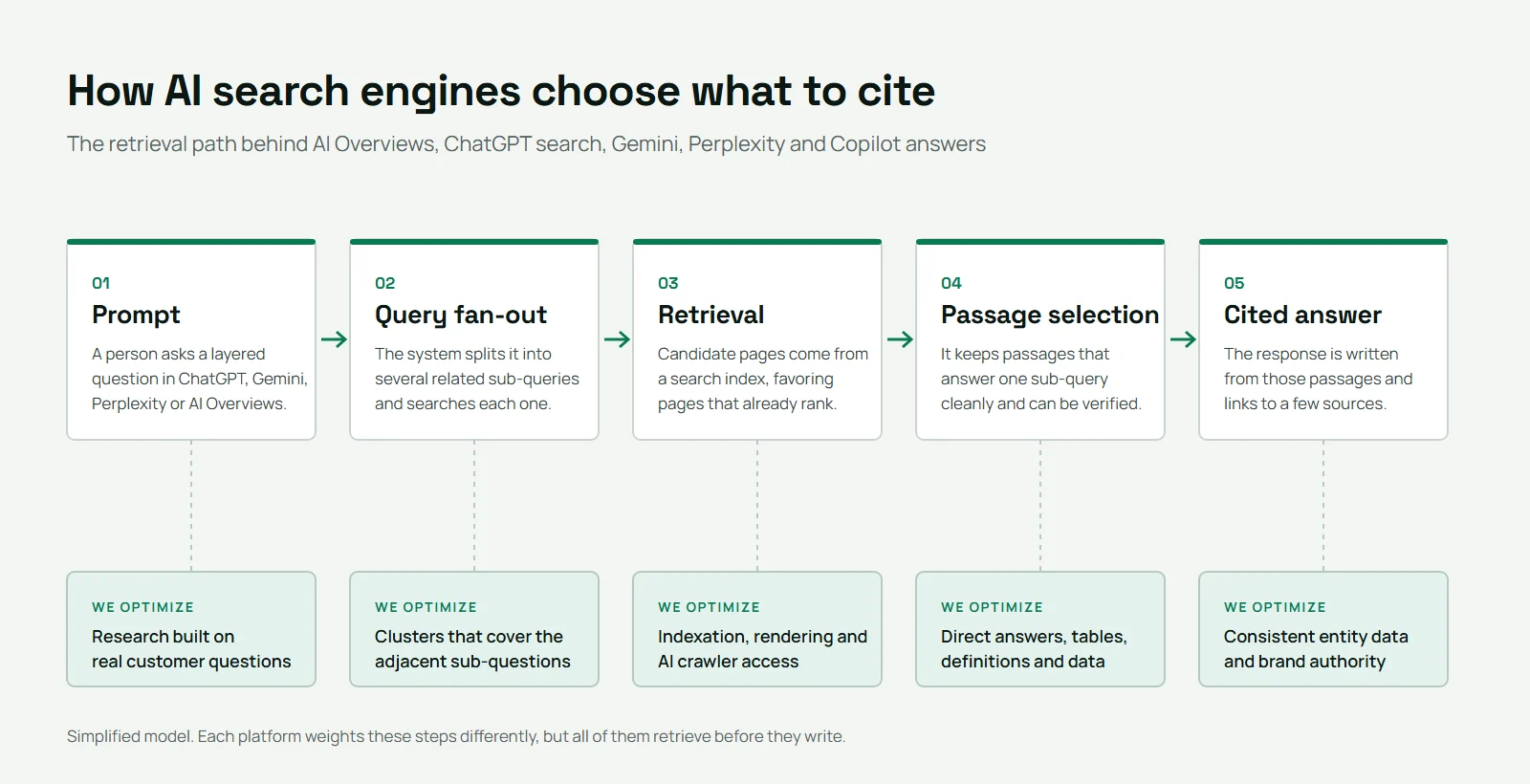
How AI search engines choose which brands to cite
Generative engines split a prompt into several related searches, retrieve candidate pages for each one, keep the passages that answer cleanly, and write a response citing a few of them. Brands get cited when they are retrievable for many of those sub-searches, and when their passages are specific enough to quote and are corroborated by other sources.
What we see moving AI visibility for large brands
- Third-party pages often carry more weight than your own. For commercial prompts, engines lean on reviews, forums, comparison articles and video, so a GEO plan limited to your domain covers about half the surface.
- “X vs Y” and “best X for Y” prompts dominate commercial AI queries, and engines tend to cite pages that compare honestly, competitors included.
- Freshness counts for more than in classic SEO. ChatGPT search and Perplexity visibly favor recently updated pages on many commercial topics.
- Strong Google rankings still predict AI Overview citations, and AEO rarely holds up without the technical foundation behind them.
Why it is harder at enterprise scale
Large organizations carry years of contradictory content. A model might find four pricing pages, two retired product names and a press release from a previous leadership team, and nothing tells it which one is current unless the site makes that obvious.
Add multiple brands, regional sites, legal review and a release calendar, and AI SEO turns into an operations problem as much as a content one. Most agencies skip that part, and it is the part we are built for.
Vague pages rarely get quoted. Specific pages with a clear source get quoted again and again.
How an enterprise AI SEO engagement runs
We baseline AI visibility, fix access and structure, build the content and entity signals that earn citations, then measure and expand. The first phase usually turns up fast technical fixes, like unblocked crawlers or server-rendered answers, while content and authority work builds over the following quarters.
Baseline
Prompt set built from sales calls, support tickets and search data. Citation share, description accuracy and crawler access measured per platform.
Fix access and structure
AI crawler rules, rendering, structured data and answer-ready templates. Most of the early gains come from here.
Earn citations
Fan-out coverage, original data, comparison pages, entity alignment and third-party presence, prioritized by pipeline value.
Measure and expand
Monthly reporting on citations, accuracy and AI-referred revenue, with the prompt set widened as new products and markets come in.
Build your prompt set from sales call recordings rather than keyword tools. The questions buyers ask a salesperson are the ones they now type into ChatGPT.
Who enterprise AI SEO is built for
Enterprise SaaS
Buyers ask AI tools to compare platforms, integrations and pricing tiers, and comparison, integration and documentation content decides who makes the shortlist. Our SaaS SEO services build those pages.
Ecommerce and retail
Product recommendations in ChatGPT and AI Mode pull from feeds, reviews and category pages. Structured product data and review depth carry the weight.
Financial services and insurance
Accuracy and compliance come first. Answer content needs review workflows, and wrong AI descriptions carry regulatory risk.
Healthcare and life sciences
Engines favor clearly sourced, expert-reviewed content. Authorship, citations and entity clarity carry extra weight in this sector.
B2B manufacturing and industrial
Specification-heavy buyers ask detailed technical questions. Spec tables and application guides become highly citable assets.
Multi-location and franchise brands
Local AI answers draw on business profiles, reviews and location pages. Consistency across hundreds of locations is the hard part, and our enterprise local SEO services are built for it.
TL;DR
- Enterprise AEO wins the extracted answer, enterprise GEO wins the citation and enterprise LLMO shapes what models say from memory. Running all three as one program is what enterprise AIO means.
- All of it depends on classic SEO, because AI engines retrieve from indexes before they write.
- Citations go to passages that are retrievable, specific and backed up elsewhere, and much of that evidence lives on third-party sites.
- At enterprise scale the hard part is operations: templates, contradictory legacy content, approvals and measurement tied to pipeline.
- Engagements start from $5,000 per month, in line with our enterprise SEO packages.
Enterprise AI SEO FAQs
What is enterprise AI SEO?
Enterprise AI SEO is the work of getting a large organization retrieved, cited and described accurately by AI search tools, including Google AI Overviews and AI Mode, ChatGPT, Perplexity, Gemini and Copilot. It combines AEO, GEO and LLMO with the technical SEO, entity data and governance a big website needs.
What is the difference between AEO, GEO and SEO?
SEO gets pages crawled, indexed and ranked. AEO structures content so a passage is pulled out as the direct answer in AI Overviews or featured snippets. GEO earns citations inside responses that ChatGPT search, Perplexity and other generative engines write from live retrieval. AEO and GEO both build on SEO rather than replacing it.
What is LLMO, and how is it different from GEO?
LLMO, or large language model optimization, shapes how a model describes your brand when it answers from training data without browsing. GEO targets answers built from live web retrieval. LLMO relies on consistent entity data, Wikipedia and Wikidata, reviews and authoritative mentions, and it moves more slowly because models are retrained only periodically.
Is GEO replacing SEO?
No. Generative engines pull candidate pages from search indexes before they write, so pages that are not indexed or trusted rarely get cited. GEO adds work on top of SEO, including coverage of fan-out sub-questions, quotable passages and third-party corroboration. Cutting SEO to pay for GEO usually weakens both.
How do you get a brand cited in ChatGPT and Perplexity?
Make sure their crawlers can reach and read your pages, and publish specific passages that answer real buyer questions in the first sentences under clear headings. Cover the related sub-questions a prompt fans out into, and earn mentions on the review sites, forums and publications those engines already cite. Original data and honest comparisons get cited most often.
How long does enterprise GEO take to show results?
Technical fixes like unblocking AI crawlers or server-rendering key content can change citations within weeks, once pages are recrawled. Content, entity and third-party work usually builds over three to nine months. Retrieval-based platforms respond faster than model memory, which only updates when models are retrained.
How do you measure AI search visibility?
We track a fixed set of buyer prompts across ChatGPT, Gemini, Perplexity, Copilot and Google AI Overviews, and record citation share against competitors and the accuracy of brand descriptions. AI referral traffic is segmented in GA4 and connected to leads and pipeline in the CRM. We report trends, because single AI responses vary from run to run.
Should we block AI crawlers like GPTBot?
It depends on the crawler and your goals. Search and retrieval agents like OAI-SearchBot, ChatGPT-User and PerplexityBot fetch pages in order to cite them, so blocking them removes you from those answers. Training crawlers like GPTBot and Google-Extended raise a separate question about content reuse. We set rules crawler by crawler as a business decision.
Does schema markup help with AI Overviews?
Structured data helps search engines understand entities, products, reviews and page purpose, which supports rich results and clearer retrieval. It works as supporting evidence, without directly switching citations on. Markup pays off when it matches visible content on pages that already rank, and it is most valuable on large sites where templates deploy it everywhere at once.
Can you fix wrong information AI tools give about our brand?
Usually, by fixing the sources behind it. We trace incorrect answers to outdated pages, PDFs, directory listings, Wikidata entries or third-party articles, then correct, redirect or replace them and publish a clear current source. Retrieval-based answers update after recrawling, while answers from model memory change more slowly as models are retrained.
How much does enterprise AI SEO cost?
Engagements start from $5,000 per month, the same starting point as our enterprise SEO packages. Cost rises with the number of brands, markets and prompts tracked, how much implementation we carry and how much content we produce. Most programs begin with a fixed-scope AI visibility audit, then continue as a monthly program alongside SEO.
Be the source AI answers are built from
AI search rewards brands that are easy to retrieve, easy to quote and described the same way everywhere. For a large organization that takes access, templates, entity work and reporting that connects citations to revenue, on top of new content.
Tell us which AI answers matter most to your business. We will show you where your brand appears today, where competitors get cited instead, and what we would fix first.
Request a Free Quote
Tell us about your site and goals. We reply within one business day.