SaaS SEO services
SaaS SEO agency for B2B software
As a SaaS SEO agency, we get your product in front of buyers while they compare tools, in Google and in AI answers. Then we tie that traffic to trials, demos and closed revenue in your CRM, so you can see what SEO is worth.
Request a Free Quote
Tell us about your site and goals. We reply within one business day.
What SaaS SEO is and where the money comes from
SaaS SEO is search engine optimization for software companies. It targets the searches people make while they evaluate tools, like comparisons, alternatives, integrations, use cases and pricing, and connects that traffic to trials, demos and revenue. In B2B SaaS, 300 visitors a month on the right comparison page can bring in more pipeline than 30,000 on a glossary.
Why it pays for software companies
Paid search gets more expensive every year for most software categories, and the clicks stop the day the budget does. Organic pages keep working. A good alternatives page can keep bringing in demos for years with a refresh every couple of quarters.
Buyers also do most of their homework before they talk to sales. They read comparison pages, check review sites, look at the integrations list and, more and more, ask ChatGPT for a shortlist. SEO for SaaS is how you get into that research while it’s happening.
The trouble we see most often is a blog with healthy traffic and almost no pipeline behind it. Posts rank for definitions that students and job seekers search. The pages a buyer would actually use, like “HubSpot vs your product” or “your product for healthcare teams”, don’t exist or sit three clicks deep.
Ten people reading your Salesforce integration page are worth more than ten thousand reading “what is a CRM”.
We think most SaaS teams should write fewer posts and better pages. Our job is to find the few dozen pages that will bring in deals, build them properly and keep them ranking.
The SaaS pages that bring in pipeline
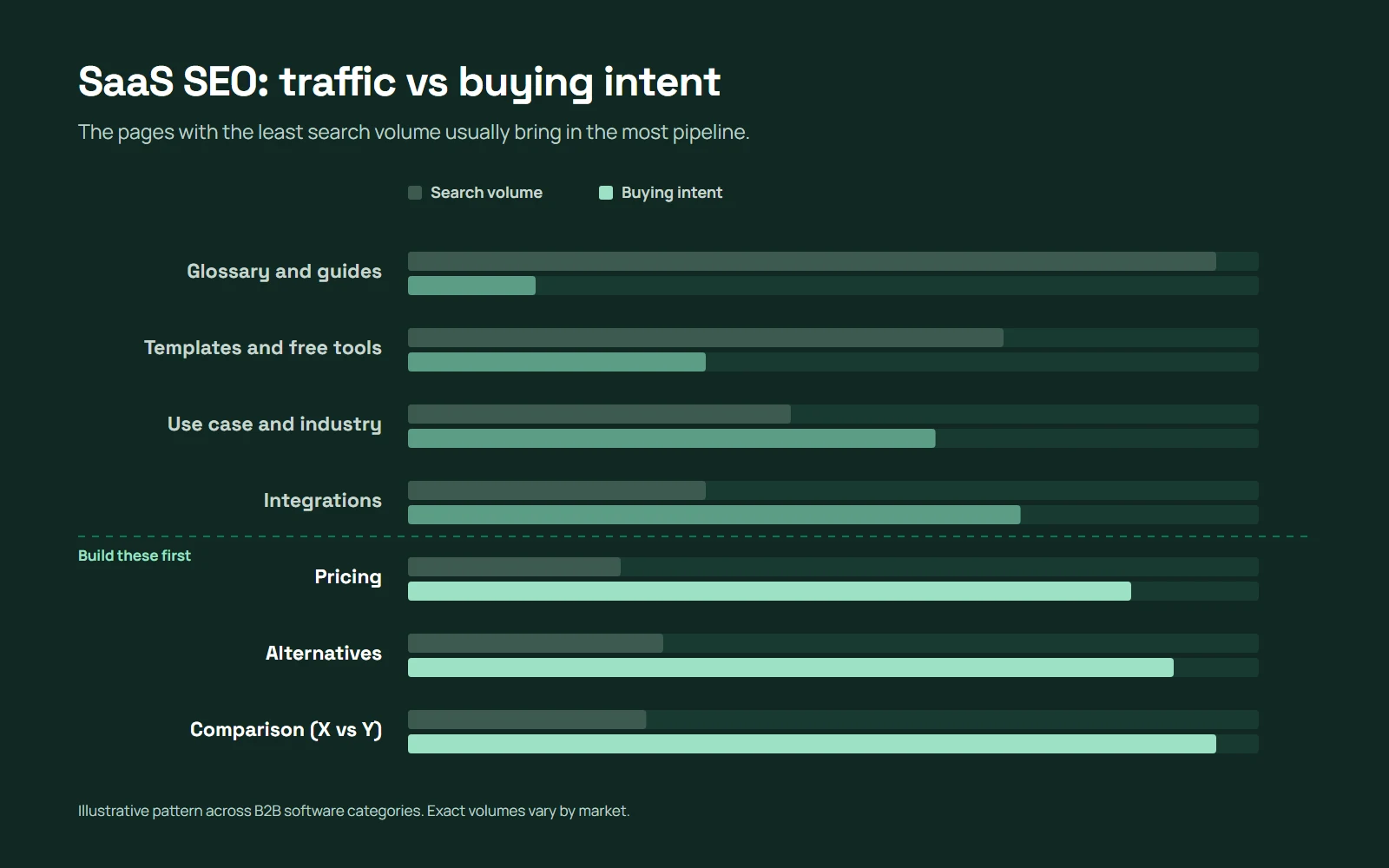
Search volume and buying intent pull in opposite directions in B2B SaaS SEO. Glossary and how-to content gets the most traffic and the fewest demos. Comparison, alternatives, integration, use-case and pricing pages get less traffic and most of the revenue. A healthy program builds the high-intent pages first, then uses educational content to support them.
| Page type | What the searcher wants | What it needs to rank and convert |
|---|---|---|
| Comparison (“X vs Y”) | A fair side-by-side before a shortlist | An honest feature and pricing table, real screenshots, and a clear note on who should pick the other tool |
| Alternatives | A way out of a current tool | Migration details, switching costs, and why people leave the incumbent |
| Integrations | Proof the product fits their stack | What syncs, in which direction, setup steps, and limits |
| Use case and industry | Evidence it works for a team like theirs | Workflows, templates and customer language from that segment |
| Pricing | Cost and plan fit | Plain plan comparisons, what triggers an upgrade, FAQ on billing |
| Templates and free tools | A quick win they can use today | Something that works without a signup wall, with a natural path into the product |
| Glossary and guides | Learning a topic | Depth and internal links to the pages above, or it stays traffic with no pipeline |
How we work as a B2B SaaS SEO agency
Most SaaS SEO agencies sell a content package: a set number of blog posts a month, priced per word. Our plans start from closed-won deals. We look for the searches your best customers made before they bought, build pages that answer them with the product on screen, and report results your finance team will recognize.
We start from your CRM
Before any keyword research, we look at closed-won deals, sales call notes and the “how did you hear about us” field. Those tell us which problems, competitors and integrations come up right before a purchase. Keyword tools come second.
The product is in the content
Our pages show the product doing the job, with screenshots, workflows and real settings. We write them with your product marketers and sales engineers, because a buyer can tell within a paragraph whether the writer has used the software.
Programmatic pages with a quality bar
Integration, template and use-case pages can be built from data at a scale of hundreds. We only ship them when each page has something a person would want to read. Thin pages built from a spreadsheet tend to get indexed, then quietly dropped.
Attribution built for long sales cycles
A B2B deal can take six months and touch ten pages. We connect GA4 to HubSpot or Salesforce, track first and assisted touches, and compare them with self-reported attribution, so SEO gets credit it can defend in a budget meeting.
If your SEO report cannot be read next to your pipeline report, it will lose the first budget fight it gets into.
Our SaaS SEO services
Our SaaS SEO services run from a pipeline-focused audit to the pages, technical fixes, links and reporting that follow from it. You can hire us for the full program, or for SaaS SEO consulting alongside an in-house team that needs a senior second opinion and an extra pair of hands.
SaaS SEO audit
We map your traffic and rankings against pipeline, then look for gaps. Which competitor comparisons are missing, which integrations have no page, where the marketing site and the app or docs subdomain split your authority, and which posts get traffic from people who will never buy.
Comparison and alternatives pages
Fair, detailed pages on how you stack up against named competitors. Legal teams often get nervous here. Your competitors are already writing these pages about you, so we help you publish an honest version with sources for every claim.
Integration and use-case pages
A page for every integration and every segment worth targeting, built from product data plus real setup detail. For companies with hundreds of integrations, we template them so each page still says something specific about that connection.
Technical SEO for SaaS sites
Next.js and React rendering checks, Webflow, HubSpot CMS and Contentful setups, marketing site and app separation, pricing page indexing, international versions and Core Web Vitals. Many SaaS sites hide key content behind tabs or client-side rendering that search engines read poorly.
Documentation and help center SEO
Docs often rank better than the marketing site for technical queries, and they reach evaluators as well as customers. We fix their structure, internal links and canonicals, and decide with you whether they belong on a subdomain or a subfolder.
Templates and free tools
Calculators, generators and templates that earn links and signups on their own. We scope these with your product team so they are cheap to maintain and lead naturally into a trial.
Digital PR and links
Data studies built on your own product or survey data, expert commentary and partner co-marketing. Software companies sit on usage data journalists would happily cite, and most never publish it.
AI search visibility for SaaS
Buyers now ask ChatGPT, Perplexity and Google AI Mode which tool to pick. We make sure your comparisons, reviews and entity data give those systems an accurate answer. Our enterprise AI SEO services go deeper on this.
SaaS SEO consulting
Strategy, roadmap reviews, migration planning and training for in-house teams. Some clients want one senior SaaS SEO expert in their planning meetings more than they want another writer.
Pipeline reporting
Dashboards that show organic signups, demos, opportunities and closed revenue by page type and topic, with brand and non-brand traffic separated so growth is not just people searching your name.
Enterprise SaaS SEO for larger software companies
Enterprise SaaS SEO covers software companies with several products, acquired brands, large documentation sites or multiple regions. The page types stay the same. What changes is coordination: merging acquired domains without losing rankings, keeping product naming consistent across thousands of pages, and getting SEO changes through brand, legal and engineering on a release schedule.
What we usually find at this size
- Acquired products still living on their old domains, competing with the parent brand for the same searches.
- Docs, community, academy and marketing sites built on four platforms, linking to each other almost by accident.
- Product names that changed twice in three years, with old names still ranking and pointing to retired pages.
- Regional sites translated from the US version without local keyword research, ranking for terms nobody there uses.
How we handle it
We treat it as an enterprise program with a SaaS content layer on top. In practice that means domain consolidation plans with redirect maps and benchmarks, and a shared taxonomy for products and features. We also build SEO checks into the release process, so a site redesign can’t quietly erase a year of work.
This is the same approach behind our enterprise SEO services, applied to the page types that sell software.
SaaS SEO mistakes we fix most often
Chasing traffic instead of buyers
Teams pick topics from the volume column in an SEO SaaS tool like Ahrefs or Semrush and end up ranking for questions their buyers never ask.
Gating the useful material
Put the best guide behind a form and search engines get a landing page with three bullet points to rank. Keep a substantial version open and gate the extras.
Hiding the product
Feature pages built as image carousels and tabbed widgets give search engines little text to read and buyers little to compare.
Rebranding without redirects
Renamed features and restructured URLs after a rebrand are one of the most common causes of sudden traffic drops we are asked to diagnose.
Judging SEO after one quarter
New pages on a young domain can take six to nine months to rank. Cutting the program at month three locks in the cost and skips the return.
Counting signups, ignoring revenue
Free signups from the wrong segment look great on a dashboard. Pipeline and retained revenue by landing page tell you which content is worth more.
Choosing an SEO agency for SaaS companies
A good SEO company for SaaS should talk about your pipeline before it talks about keywords. Ask any agency or consultant how they pick topics, how they work with product marketing, what they publish about competitors and how they report revenue. If the answers revolve around posts per month and domain authority, keep looking.
Questions to ask before you sign
- Which B2B software companies have you worked with, and at what stage?
- How would you use our CRM data to choose topics?
- Can you show a comparison page you wrote and the pipeline it produced?
- Who writes the content, and have they used software like ours?
- How do you handle programmatic pages without making them thin?
- What will you report each month, and how does it connect to revenue?
Agency, consultant or in-house hire?
| Option | Works well when | Watch for |
|---|---|---|
| SaaS SEO agency | You need strategy, content, technical work and links at once, plus patterns learned from many software companies | Juniors writing about a product they have never opened |
| SaaS SEO consultant | You have writers and developers and need direction, audits or a migration plan | One person cannot produce pages at volume |
| In-house SEO hire | SEO is a core channel and you want someone inside every planning meeting | One generalist rarely covers content, technical SEO and PR equally well |
Plenty of our clients combine them. An in-house lead owns the roadmap, and we act as the specialist bench for the work they cannot staff.
How a SaaS SEO engagement runs
We start with your pipeline data and a technical audit, build a page plan ranked by revenue potential, ship the high-intent pages first and then grow into supporting content, links and AI visibility. Reporting runs monthly, and the plan gets re-ranked each quarter as deals close and the product changes.
Pipeline and site audit
CRM and sales call review, competitor gap analysis, technical audit of the marketing site, docs and app.
Page plan
Comparison, alternatives, integration, use-case and pricing pages ranked by expected pipeline, with briefs your team can review.
Build and ship
Pages written with product input, technical fixes, programmatic templates where they make sense, links and PR.
Report and re-rank
Monthly pipeline reporting by page type, with the plan re-ranked every quarter.
Ask your sales team for the five competitors they lose deals to most often. Pages for those comparisons are usually the fastest SEO revenue a software company can get.
Where SEO fits in SaaS marketing
In SaaS marketing, SEO tends to get treated as the slow channel next to paid search and outbound. That framing undersells it. Paid buys attention for as long as you pay. SEO builds pages that sales can send to prospects, that paid campaigns can land on and that AI assistants can cite when someone asks for a recommendation.
We work best when SEO shares a plan with product marketing and demand gen. Comparison pages give sales reps something to send. Integration pages support partner launches. Data studies give PR something to pitch, and the same pages feed local and international campaigns when the product sells by region. When those teams plan together, each page gets used three or four times instead of once.
SaaS SEO FAQs
How much do SaaS SEO services cost?
Our SEO packages start from $5,000 per month. Beyond that, what a SaaS SEO company charges depends mostly on how many pages need building and how much technical work the site needs. Who writes the content, and how much link building and reporting you want, also move the number. Most programs start with a fixed-scope audit and page plan, then move to a monthly retainer. We scope from your data rather than a fixed package.
How long does SEO take to work for a SaaS company?
Technical fixes and improvements to existing pages can show results within one to three months. New pages on an established domain often rank within three to six months, and on a young domain it can take six to nine. Comparison and integration pages usually pay off sooner than educational content, because the people searching are already shopping.
Is SEO worth it for early-stage SaaS companies?
Usually yes, if you focus. SEO for SaaS companies at seed or Series A should start with a small set of high-intent pages: two or three comparisons, the main alternatives page, top integrations and core use cases. A glossary of 200 terms can wait. Those first pages also give sales material to send prospects.
Should we write comparison pages about our competitors?
Yes, as long as they are fair. A page you control beats a third-party version written from old screenshots. Use current pricing and features, cite your sources, show the product, and say plainly when the other tool is a better fit. Buyers notice that candor, and it makes the rest of the page believable.
What is the difference between SaaS SEO and regular SEO?
Both rely on crawlable pages, useful content and earned links. SaaS SEO differs in what it targets and how success gets measured. It focuses on evaluation searches such as comparisons, integrations and use cases, involves product content and documentation, and is judged on revenue over long B2B sales cycles.
Do SaaS companies need programmatic SEO?
Only when you have a real data source behind it, like hundreds of integrations, templates or industries with meaningful differences. Programmatic pages work when each one answers a specific question well. When they only swap a name into the same paragraph, search engines index a few and ignore the rest.
Should our docs live on a subdomain or a subfolder?
Both can rank. Subfolders make internal linking and shared authority simpler, which is why we usually recommend them when the platform allows it. If docs must stay on a subdomain, strong links between the docs and the marketing site and a consistent navigation do most of the same work.
How do you measure SEO ROI for B2B SaaS?
We connect organic sessions and conversions in GA4 to opportunities and closed revenue in HubSpot or Salesforce, separate brand from non-brand traffic, and look at first touch and assisted influence over the full sales cycle. Self-reported attribution on demo forms fills gaps that tracking misses.
Can SEO help our SaaS product show up in ChatGPT answers?
Yes. ChatGPT search, Perplexity and Google AI Mode pull from pages that rank and from review sites, forums and comparison articles. Strong comparison pages, accurate G2 and Capterra profiles, clear product naming and mentions in industry coverage all make it more likely your product is recommended when buyers ask for options.
Build the pages your buyers are already looking for
Your buyers are comparing tools right now, on pages someone else wrote unless you write them first.
Send us your site and the competitors you lose to most. We’ll come back with the pages we would build first and what we expect them to bring in.
Request a Free Quote
Tell us about your site and goals. We reply within one business day.