
Enterprise local SEO services
Enterprise local SEO for every location
Our enterprise local SEO services grow map pack rankings, calls, direction requests and store visits for brands with dozens to thousands of locations, by running location data, Google Business Profiles, location pages and reviews as one governed system.
Request a Free Quote
Tell us about your site and goals. We reply within one business day.
What enterprise local SEO is and why it pays
Enterprise local SEO is local search optimization for brands with many physical locations or service areas. It keeps every location accurate and visible in Google Maps, the local pack, Apple Maps, Bing and AI answers, through central location data, Google Business Profile management at scale, crawlable location pages, review operations and reporting per location.
Where the value comes from
Local searches carry intent most channels never see. Someone typing “urgent care near me” or “tire shop open now” is choosing where to go in the next hour, and the three businesses in the map pack win most of those decisions.
For a multi-location brand the upside multiplies. A one-place gain in the local pack looks small at a single store. Across 400 stores it adds up to a measurable lift in calls, bookings and foot traffic. Much of that revenue never gets credited to search, because the sale happens at a counter.
Mistakes multiply the same way. One wrong holiday-hours update pushed to every listing can send customers to locked doors across a whole region in an afternoon.
Past a few hundred locations, local SEO is mostly data operations with a marketing layer on top.
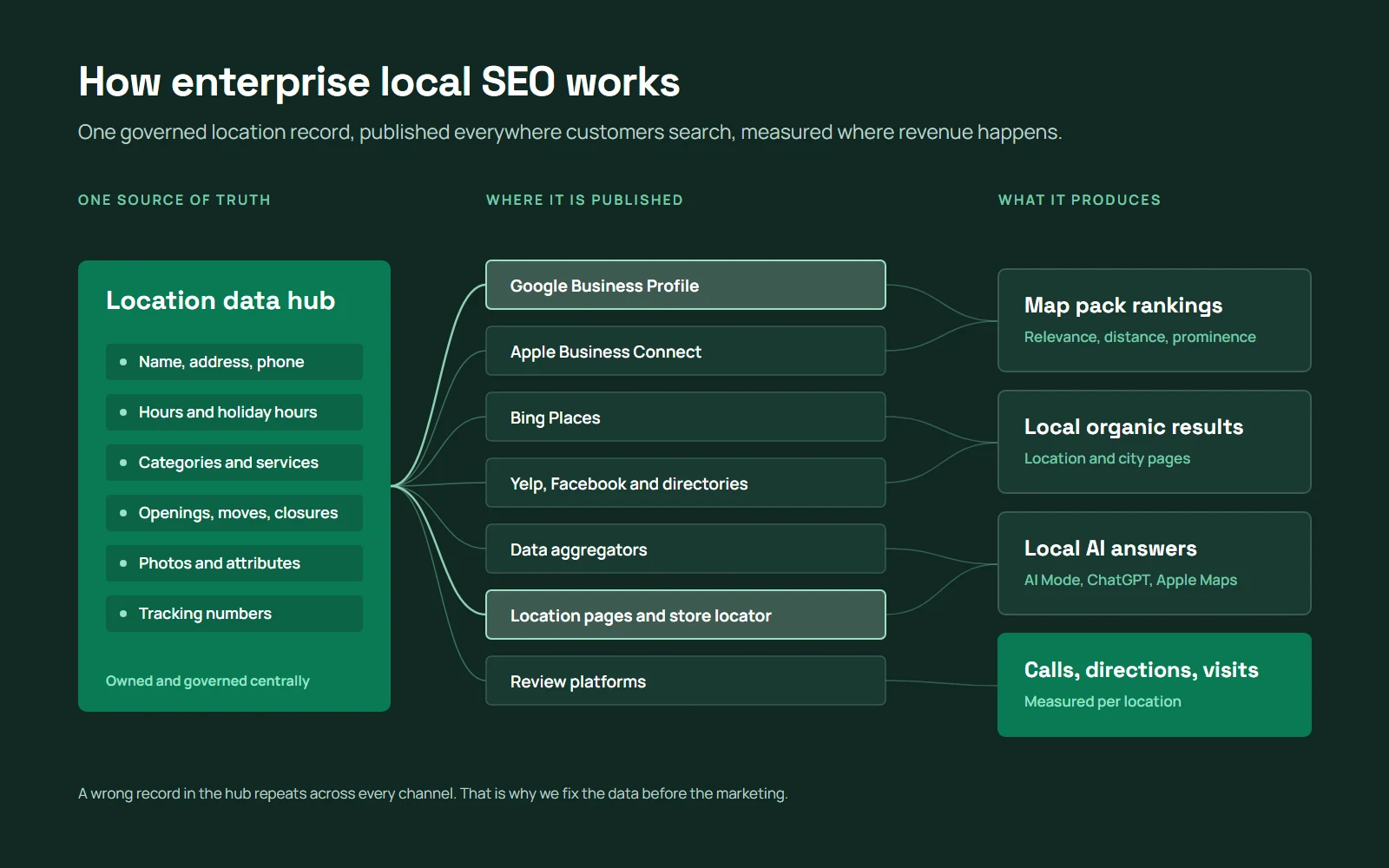
In most multi-location brands we audit, the search problems trace back to location data. We fix the data first, and the marketing starts working once the records underneath it are right.
How enterprise local SEO works across many locations
Google ranks local results on relevance, distance and prominence. Distance depends on where the searcher stands, so enterprise local SEO works on the other two across every location. Accurate, well-categorized listings drive relevance, while reviews, links and strong location pages build prominence. Everything starts from one governed location record that feeds every channel.
Enterprise local SEO vs. single-location local SEO
| Dimension | Single-location local SEO | Enterprise local SEO |
|---|---|---|
| Listings | One Google Business Profile, edited by hand | Hundreds or thousands of profiles managed through bulk tools and the API |
| Data | The owner knows the hours | Hours, openings and closures flow from operations, real estate and franchisees |
| Website | A contact page with an address | A crawlable store locator, state and city hubs, and a page for every location |
| Reviews | Reply when someone posts | Request flows, response playbooks and sentiment tracked by location and region |
| Main risk | Being invisible | Errors, duplicates and suspensions repeated at scale |
| Reporting | Overall calls and visits | Every location benchmarked against its market, with underperformers flagged |
What sets our enterprise local SEO services apart
Most enterprise local SEO services providers sell a listings tool and a monthly posting calendar. We run local search as an operations system, with one governed record per location, location pages built from templates, franchise-ready workflows and reporting that ties every location to calls, bookings and visits.
We fix the data before the marketing
We reconcile your location master data with what Google, Apple, Bing and the aggregators actually show, merge duplicates, claim orphaned profiles and set the rules for who can change what. Posting and review campaigns only pay off once the records underneath them are right.
Location pages with real local substance
Pages that differ only by city name rank poorly and can look like doorway pages. Our templates pull in what is specific to each site: the services offered there, staff, parking and access details, nearby areas served, local reviews and FAQs.
Built for franchise and multi-brand structures
Franchisees open profiles, change phone numbers and answer reviews in their own voice. We set up permission levels, brand guardrails and approval flows that keep central control without slowing local teams down.
Reporting per location, tied to revenue
Calls, direction requests, bookings and website visits are reported for every location against its own market, so regional leaders can see which stores lag and why.
Software can push a phone number to 70 directories. It has no way of knowing the number is wrong, or that the store should be listed as an urgent care clinic.
Our enterprise local SEO services
Our enterprise local SEO services cover a multi-location audit, Google Business Profile management at scale, location data syndication, location pages and store locator SEO, review operations, local authority building, local AI search visibility and reporting per location. They plug into your operations calendar, so openings, moves and closures reach search the same day.
Enterprise local SEO audit
Listing accuracy against your master data, duplicate and unclaimed profiles, primary and secondary category choices, NAP consistency across aggregators, location page index coverage and grid-based rank tracking that shows visibility block by block across a market.
Google Business Profile management at scale
Bulk and API management of categories, attributes, services, products, photos and posts across every profile, plus verification for new locations and suspension recovery when a profile gets flagged. We set the tracking number as the primary phone and keep the real number as an additional one, so call attribution works without breaking listing consistency.
Location data management and syndication
One governed record per location, published to Google, Apple Business Connect, Bing Places, Yelp, Facebook and the major data aggregators. Holiday hours, temporary closures, relocations and permanent closures are scheduled ahead of time from the operations calendar.
Location pages and store locator SEO
Many store locators load results with JavaScript and give search engines no crawlable links to individual stores. We build locators with real links, state and city hub pages, a unique page for every location and LocalBusiness schema that matches the profile exactly.
Review generation and response
Policy-compliant review requests built into the service flow, with no review gating. Response playbooks for local teams, escalation rules for complaints and sentiment tracked by location, so operational problems surface before they become rating problems.
Local links and authority
Sponsorships, community partnerships, local press and chamber listings that earn genuine local links, run with the same enterprise SEO standards we apply to national campaigns. For a multi-location brand we run this as a repeatable program regional managers can actually follow.
Local AI search visibility
AI Mode, ChatGPT and Apple Maps answer “best near me” questions using business profiles, reviews and location pages. We make sure those sources describe each location accurately. Our enterprise AI SEO services cover this in depth.
Reporting and governance
A dashboard built on Google Business Profile performance data, call tracking and web analytics, showing calls, directions, bookings and visits per location and region, plus alerts when a listing is edited, suspended or drops out of the pack.
What we find in multi-location audits
The same problems come up in almost every enterprise local SEO audit. We find duplicate and unclaimed listings, store locators that search engines cannot crawl, location pages that differ only by city name, primary categories nobody has checked in years and rank tracking that hides the real picture.
- Duplicates split ranking signals. An old profile at a previous address, or a franchisee’s own listing, competes with the official one and divides the reviews between them.
- The primary category is one of the strongest local ranking levers and one of the most neglected. Whoever opened the profile usually set it, sometimes years ago.
- Closed locations linger. Profiles for shut stores that were deleted rather than marked permanently closed can reappear with wrong data and send customers to empty buildings.
- Single-point rank tracking misleads. A store can rank first from its own parking lot and vanish two miles away, and grid tracking shows where visibility actually ends.
- Thin location pages underperform. When 600 pages share one paragraph with the city name swapped, Google shows a few and ignores the rest.
- Some listings tools leave you renting your own data. With certain platforms, corrections hold only while the subscription runs, so we check what happens to your data before you sign or cancel.
How to compare enterprise local SEO services providers
Judge providers on how they handle location data, since the number of directories they list tells you little. The top enterprise local SEO programs combine central data governance, Google Business Profile work at API scale, crawlable location pages, review operations and reporting per location. Ask any provider to walk you through a store opening, a relocation and a closure from start to finish.
Questions worth asking before you sign
- How do you handle duplicate and unclaimed profiles, and how long does cleanup take?
- What happens to our listing data if we stop working with you?
- How are franchisee or local manager permissions controlled?
- How do you make location pages unique at our scale?
- Do you report calls, directions and visits for every location?
- How do you track visibility across a whole market?
Listings software, agency or in-house team?
| Option | Best for | Watch out for |
|---|---|---|
| Listings software | Pushing consistent data to many directories quickly | It syndicates whatever data you give it. Categories, pages and reviews still need someone to own them. |
| Enterprise local SEO agency | Strategy, cleanup, location pages, reviews and reporting across every channel | Check that the agency answers for calls and visits, beyond a posting calendar. |
| In-house team | Day-to-day updates and close ties with operations | Hard to keep pace with Google changes across hundreds of locations alone. |
The setup we see working best is listings software as the pipe, an in-house owner for location data, and an agency running strategy, pages, reviews and reporting on top.
How an enterprise local SEO engagement runs
We audit every location, clean up the data and listings, rebuild location pages and the store locator where needed, then run reviews, authority and reporting as an ongoing program. Cleanup usually produces the fastest wins, because fixing duplicates, categories and wrong data often lifts visibility within weeks.
Audit every location
Listings, duplicates, categories, page coverage and grid rankings for each location, benchmarked against local competitors.
Clean up and govern
Master data reconciled, duplicates merged, profiles claimed, permissions set and syndication connected.
Build the location layer
Store locator, hub pages and location pages rebuilt as a template system with schema that matches each profile.
Grow and report
Reviews, posts, local links and AI visibility, with monthly reporting per location and region.
Connect your real estate and operations calendars to local SEO. Most listing errors we fix started as an opening, move or closure that nobody told marketing about. Ask us how we connect those calendars to listings.
Multi-location brands we build local SEO for
Retail chains
Store hours, inventory signals and holiday changes across hundreds of stores, with location pages that support “in stock near me” searches.
Restaurants and QSR
Menus, ordering links, hours and review volume drive the pack, and fast replies to reviews matter more here than in most categories.
Healthcare systems
Hospitals, clinics, urgent care and individual practitioner listings, each needing the right category and accurate services.
Banks and credit unions
Branches, ATMs and specialist advisors, with compliance review on every public-facing change, the same approval model we use for regulated AI search content.
Automotive dealer groups
Separate sales, service and parts departments per rooftop, each with its own hours and categories.
Home services franchises
Service-area businesses where the address is hidden and visibility depends on service areas, reviews and city pages.
TL;DR
- Enterprise local SEO keeps every location accurate and visible in maps, local packs and AI answers, and ties each one to calls, directions and visits.
- Google ranks local results on relevance, distance and prominence, and enterprise programs work on relevance and prominence across every location.
- Most multi-location problems start as data problems: duplicates, wrong categories, stale hours and closures nobody recorded.
- Location pages need real local substance and a crawlable store locator before most of them will rank.
- Programs start from $5,000 per month, in line with our enterprise SEO packages.
Enterprise local SEO FAQs
What is enterprise local SEO?
Enterprise local SEO is local search optimization for organizations with many locations or service areas. It covers central location data, Google Business Profile management for hundreds of profiles, location pages and store locators, review operations and reporting per location. The goal is for every site to rank in maps and local results and drives calls, directions and visits.
How is enterprise local SEO different from regular local SEO?
Regular local SEO handles one or a few listings by hand. Enterprise local SEO manages hundreds or thousands through bulk tools and APIs, with data governance, permissions for franchisees or local managers, template-based location pages and reporting that compares every location against its market. The main risk also changes, from being invisible to repeating one error across hundreds of listings.
How much do enterprise local SEO services cost?
Programs start from $5,000 per month, in line with our enterprise SEO packages. Cost rises with the number of locations, how much listing cleanup is needed, whether location pages have to be rebuilt, review volume and reporting depth. Most programs begin with a fixed-scope audit and cleanup, then move to a monthly retainer.
How long does enterprise local SEO take to work?
Cleanup work like merging duplicates, fixing categories and correcting hours often lifts visibility within weeks, once Google processes the changes. Rebuilt location pages and a crawlable store locator usually show results over two to four months. Review and local link programs keep building from there, location by location.
How do you manage Google Business Profiles for hundreds of locations?
We group profiles into a business account with location groups, manage core data through the Business Profile APIs or bulk uploads, and sync it with a single location record. Categories, attributes and services follow templates by location type, while photos, posts and review responses run on schedules with local approval rules.
Do we need a separate page for every location?
In most cases, yes. A dedicated location page gives each Google Business Profile a matching website link, supports local organic rankings and answers practical questions about parking, services and hours. Each page needs real local content and LocalBusiness schema, and it must be reachable through crawlable links from a store locator or city hub.
How do reviews affect local rankings?
Review count, rating, recency and the words customers use all feed prominence, one of Google’s three local ranking factors. Reviews also drive clicks once a listing is visible. For multi-location brands, steady review flow and timely responses at every location matter more than a high average at a few flagship stores.
What should we do with listings for closed or relocated locations?
Mark closed locations as permanently closed rather than deleting them, because deleted profiles can be recreated from third-party data with outdated details. For a move, update the address on the existing profile so its reviews carry over. Redirect old location pages to the new or nearest location, and update the aggregators so the change spreads.
Should we use listings software like Yext or Uberall?
Listings platforms are good at pushing consistent data to many directories quickly, and many enterprise brands should use one. They publish whatever data you give them, though. Someone still has to choose categories, fix location pages, run reviews and check what happens to your listings if the subscription ends.
How do you measure ROI from enterprise local SEO?
We track calls, direction requests, website clicks and bookings per location from Google Business Profile performance data, call tracking and analytics, then connect them to sales or store visit data where available. Comparing locations before and after changes, and against similar locations not yet in the program, shows the incremental lift.
How does AI search affect enterprise local SEO?
AI Mode, ChatGPT and other assistants answer “best near me” questions using business profiles, reviews, location pages and third-party sites. Accurate listings, detailed services and strong review content make a location easier to recommend. Local AI visibility rests on the same data foundation as the map pack, which makes that foundation worth even more.
Make every location easy to find and easy to choose
Local search decides where customers go today. For a brand with hundreds of locations, winning it takes clean data, pages with real local substance, steady reviews and reporting that shows which stores are falling behind.
Send us your location count and markets. We will show you where listings are wrong or duplicated, which locations are missing from the pack and what we would fix first.
Request a Free Quote
Tell us about your site and goals. We reply within one business day.